Showing posts with label links. Show all posts

A Simple Guide to Being Present

by Saturday, December 05, 2009
Zen Habits really just has some of the best articles! Here is an excerpt, and I encourage you to pop over and read the rest for yourself:

"How often are you driving while talking on a cell phone, or thinking about work problems, or the errands you have to do? How often do you eat without thinking about the food you’re eating? How often do you drift off while doing other things, thinking about something you messed up on, or worrying about something that’s coming up?

I would submit that most of us are elsewhere, much of the time, rather than in the here and now.

If I could only give one word of advice to someone trying to find peace in an overwhelming and stressful and chaotic world, it would be this: simplify. But if I could give two more words of advice, they’d be: be present."

This article came from a suggestion from commenter Mark, after I wrote about ways to create a peaceful, relaxed workday. It’s an article I’d been planning to write for some time, but Mark spurred me to do it sooner — so thanks Mark!

Focus On Now
There are three things we can think about:

1. The past. Reliving things we messed up about. Being embarrassed about something we did. Wishing we could have something back that is gone. Living in memories of good times past. Being angry about things done to us. You get the idea.
2. The future. Worrying about things we need to do later. Worrying about what might happen, or a big event coming up. Being anxious that things might go wrong, or that we might mess up. Hoping for something wonderful. Dreaming of great things to come.
3. The present. What is happening right now, at this moment. What we are doing now.

It is inevitable that we will think about all three. We cannot stop ourselves from thinking about the past or the future. However, with practice, we can focus on the present more than we already do.

But why should we do that? What’s wrong with focusing on the past or future? Nothing’s wrong with it. It isn’t wrong to think about past or future. However, there’s nothing we can do about things that have already happened, and worrying or agonizing about them doesn’t usually do us much good. I’d suggest analyzing what happened, learning from it, and moving on. It’s much healthier.

We also can’t control the future. It’s impossible. We can do things that will change the future, but they might change the future in ways we cannot anticipate. Or they might not change things at all. And the only thing we can do about the future is do something … now. In the present. So focusing on what we do now is the best way to improve the future. Not thinking about the future. I’m not saying you shouldn’t have goals or shouldn’t plan — but goals change (I know this first-hand, as my goals at the end of 2007 were completely different from what they were at the beginning). Plans change. We must be prepared for that change not by overplanning, but by being in the moment and rolling with the punches.

There’s also the problem of missing the present. If we spend most of our time thinking about the past or future, we are missing life itself. It’s passing us by while we’re elsewhere. You can’t get the most out of life unless you learn to focus on being present, while things are happening. Thinking about your childhood, or your kid’s future, is useless if your kids’ childhood is passing by without you being there.

Benefits of Being in the Moment
I’ve noticed a ton of benefits from my increased focus on the present. Here are just a few to consider:

1. Increased enjoyment. I find that I enjoy life more if I’m present rather than having my mind elsewhere. Food tastes better, I have more fun with my family, even work becomes more enjoyable.
2. Reduced stress. Worrying about the past and future gives you stress. But being present is almost like meditation. There are no worries. There is just experiencing.
3. Better relationships. When you really commit yourself to being with someone, to listening to them, you are being a better father, husband, friend, daughter, girlfriend. You have better conversations. You bond.
4. Get things done. I find that focusing on what I’m doing, rather than trying to multitask or multithink a million different things at once, I actually complete what I’m doing, do a better job on it, and get it done faster. I don’t necessarily do more, but I get things done. Focus tends to get things done, in my experience, and when your focus is split among a lot of things, it is less powerful.

The Magic of Flow
There’s a concept called Flow that’s been pretty popular among productivity circles in the last couple of years. I’m a big fan of it myself. In a nutshell, it’s basically losing yourself in whatever you’re doing — reaching that magical zone where you forget about the outside world and are completely doing what you’re doing, whether that’s writing or drawing or coding or whatever.

It’s a wonderfully productive zone to be in, and a state that also, incidentally, makes you happier. Productive and happier at the same time. Hard to beat that.

However, it can’t happen if you’re switching between tasks or thinking about the past or the future. It basically happens when you are in the present. So practicing being present will help you get to flow, which makes you happier and more productive. Best argument yet for being present, perhaps.

Practice, Practice
There’s no single method that will get you better at being present. I don’t have the magical formula, except one word that I often tell my kids when they’re learning anything or striving to be better at anything: practice.

You won’t be good at it at first, most likely. Your mind will wander, or you’ll do a lot of “meta-thinking”, which is just thinking about what you’re thinking, and whether you’re thinking it the right way, and whether there is a right way … and so on, until you’re no longer in the present. That’s normal. We all do that, I think.

Don’t beat yourself up about that. Don’t get discouraged. Just practice.

So what’s the magical method for learning to be present? Practice.

You do it in the morning. You practice it while eating lunch. You do it with your evening jog or walk. You do it while washing dishes after dinner. Every opportunity you get, practice.

And you’ll get better. I promise.

One Month Challenge
The best method I can offer for learning to be present, the best method for practicing, is to focus on it for one month. Make focusing on being present a habit. If you make it your only focus, I guarantee you’ll get better at it, and more importantly, you’ll get into the habit of remembering to focus, of remembering to practice, of being more aware.

Do a one-month challenge. It’s the best method for forming new habits, and it works for being present. A good way to do this is join the monthly challenge on the Zen Habits forums. Then do the following:

* Tell people on the forum what your monthly challenge will be (focusing on being present).
* Log in daily to report on your progress. This gives you the accountability and motivation needed.
* Do the tips below every day for a month.

“The living moment is everything.” - D.H. Lawrence

Tips On Being Present
You just knew I couldn’t end this post without a list of tips. So here are things that have worked for me … pick and choose the ones that you think will work best for you:

1. When you eat, just eat. The best way to think about being present is this: do just one thing at a time. When you are eating, don’t read or think about something else or iron your clothes (especially if you’re eating something that might splatter on the clothes). Just eat. Pay attention to what you’re eating. Really experience it — the taste, the texture. Do it slowly. Same thing with anything else: washing dishes, taking a shower, driving, working, playing. Don’t do multiple things at once — just do what you’re doing now, and nothing else.

2. Be aware. Another important step is to become more aware of your thoughts. You will inevitably think about the past and future. That’s OK. Just become aware of those thoughts. Awareness will bring change.

3. Be gentle. If you think about the past or future, do not beat yourself up about it! Don’t try to force those thoughts out of your head. Just be aware of them, and gently allow them to leave. Then bring yourself back to the present.

4. Zazen. Ah, you were wondering when Zen Habits would have anything to do with Zen, right? Zazen is basically the center of Zen practice. It’s simply sitting. It’s a form of meditation, but really it’s just sitting. You don’t have to contemplate Zen koans or the meaning of the universe or chant anything. You just sit, and focus on sitting. I haven’t done this much recently, but when I have, it has been very useful practice for me.

5. Exercise. These days, exercise is my zazen. Running is my sitting practice. I run, and try to only run. I focus on my running, on my breathing, on my body, on nothing but the present. It’s great practice.

6. Daily routines. Anything can be your zazen. When you wash dishes, this is practice. This is your meditation. When you walk, focus on walking. Make anything you do become practice.

7. Put up reminders. A reminder on your fridge or computer desktop or on your wall is a good thing. Or use a reminder service to send you a daily email. Whatever it takes to keep your focus on practicing being present.

8. There is no failure. You will mess up, but that’s OK, because it is impossible to mess up. The only thing that matters is that you practice, and over time, if you keep doing it, you will learn to focus on the present more often than you do now. You cannot fail, even if you stop doing it for awhile. Doing it at all is success. Celebrate every little success.

9. Keep practicing. When you get frustrated, just take a deep breath. When you ask yourself, “What should I do now, Self?”, the answer is “keep practicing”.


This article was re-printed with permission from the fabulous Zen Habits blog!

Teachers - by T. Thorn Coyle

by Friday, September 04, 2009

T. Thorn Coyle posted this over on her Facebook and I enjoyed it so much that, with her permission, I wanted to share it here with you all. Don't know who Thorn is? Why, she is one of the original members of FatChance (pictured right with Paulette, at the Ancient Echoes Retreat), and while she doesn't dance much these days, she is a big part of the tribal family tree.

Read other thoughts by Thorn HERE

At the gym this morning, my body, mind, and emotions felt engaged. My breath was working and energy was flowing. My muscles strained and my heart pumped. I felt really good. There were some things that just felt strong in the workout, and other things I could barely do today, but did them anyway, as I was able to sense the ways in which they were helping me to grow more powerful.

Sound familiar? Yes. It is the same with any practice: the stretching, the engagement, the feeling good, and the feeling at the edge of our comfort zone.

My workouts last week were nothing like this. I was doing things by rote, and because I felt I should. My mind and emotions were not very engaged, though I made attempts at being present and aware, and at moving energy, because I have enough other training to do so. The contrast with this morning was huge. Last week, I had to try to harness and move energy, this week, the energy just moved, and I could concentrate on controlling where it went, and on moving my body in a more finely tuned fashion. It felt great.

What made the difference? I got a teacher.

I haven't done serious weight training in years and have just been going on what I learned in the late 80s, early 90s, during my FatChanceBellydance years. Needless to say, this time around, I did some of what I remembered, and did not push myself very hard, because despite having worked really hard in my life to get into my body and to feel physically engaged, my natural default is that of the intellectual: to be physically lazy. Hard for some of you to believe, I am sure, but it is true. All of my physical presence and awareness is the product of many years' practice and effort. Being in my body did not come naturally to me (and what does that say about alienation in our culture?). So my current workout felt minimally satisfying. But as physical exercise is one of my commitments to spiritual practice, I decided to get help.

Through a serendipitous turn of events, I was able to work out some barter of spiritual direction for physical coaching with Carey Rockland, a skilled athlete with a lot of training, good presence, and some intuitive skills. And yes, she's hot too, which always helps a workout. She pushed me some, corrected body placement, and gave me dynamic and interesting things to do with free weights, which are my favorites. I even got to say, "I can tell I'm going to have some resistance to this" which is something I get from my students all the time. We are always looking at the information that arises from resistance.

Today I took the workout she gave me and did it on my own. And loved it.

This was a good reminder to me of why teachers and mentors are so helpful. They see us for who we are and push us in directions we did not even know we could go. They bring their expertise to bear on our bodies, minds, emotions and spirits, and help us find our way. They encourage us to do things we don't want to do, things we resist, and show us the power that flows from these things over time. They enable us to expand into what is possible.

Name correction!

by Thursday, August 27, 2009

I managed to muck up Megan Hartmann's name, despite even going to check to make sure I had it right. *smack forehead* Sorry Megan!!

So make sure you pop over and visit http://meganhartmann.wordpress.com/ to bear witness to her bloggy awesomeness! She is linked in my blogroll at the lower left sidebar of my blog as well.

Carolena can read minds...

by Wednesday, July 29, 2009
...and other wonderful tidbits in Part 1 of 2 interviews with Carolena and Megha by a couple of gals in Florida, Mary and Tammy. I love especially the discussion of preparing students for performance starting at around 25 minutes.

http://www.yippodcast.com/2009/07/episode-11a-fatchance-interview-pt-1.html

Here is a transcribed snippet, from around :50, in brief, to whet your whistle:

Yip: "Through the years...how do you keep ATS fresh? I mean, do you guys add in new moves, and how do you decide if you're gong to add something in or...the creative process behind that."

Carolena: "You know, I don't even think about keeping it fresh. I just do it. And I don't consciously say, you know, 'This is getting stale. We need a new move." We just do what we do.

And it's like an energy bounce. It just keeps rolling and rolling and rolling, and I just, I follow it. I don't direct it. D'you know what I mean? It's like I really feel like it never really intended for it to happen in the first place. It just sort of showed up and like, said, 'Chase me,' and I was like 'Okay, I'll chase you.'

And it's still like that. I really feel like there is a Dance Goddess who wanted me to present this to everybody, and I was like, 'Me? I'll try.' And she's been running ahead of me all these years..."


Around at 53ish, here is a final favorite snippet...
Carolena: "Being onstage, I feel, is really like a moving meditation. Because, you can't be anywhere but right there. You can't be ahead of yourself or behind yourself. You just...all you can be is right there. And you're either doing what you intended to do or not... ...it just flows.

When you're really like, right in that spot, it's so satisfying, because nothing else is happening right then...it's really like a single pointed meditation. It's fabulous."

Megha: "And I think also, with this style, what the audience sees, whether it's due to your successful attempt to do something or your mistake at doing something; the audience sees, whether they are conscious of it or not, the cooperation that's happening within the group. We talk a lot about how the audience sees the spark of creativity, because you're making the decisions as you go along about the sequence of things that you're gonna to, and they can see that exciting part of it. But they also can intuit the cooperation that's happening. Like, if there's a mistake and no-one gets frazzled about it, there is something that happens within that group that they can pick up on, and it just makes the whole thing even more mesmerizing and special. I love that about it."

Carolena: "Yeah, it's true that there really is a communication between the dancers and the audience. And that's what I really try to impress upon people when I'm teaching them, is being natural on stage. Be your natural self, because the audience is being its natural self, and they are looking for natural gestures. So don't be fake.


Definitely be showy. Y'know, be on the stage, and own the stage, and give us a show, for sure. But be yourself, because the audience can read a natural gesture. So if something is a success or a failure, they may or may not be able to figure that out, but your response to it is what they're going to trigger their response from. So if you look, y'know, you're just like "Oops!" and the other dancer is like "Hey, I'll help", the audience is like "Oh, that's cool".

Megha: You know, it all comes down to "Just be cool". Whatever, just be cool!

You don't love dance...

by Monday, July 27, 2009
Discovered that Aziza S'aid has a blog, and really enjoyed her post today on why we (don't) love the dance. Give it a read!
http://azizasaid.wordpress.com/2009/07/27/its-4-am-and-my-brain-is-burning/

You do not love yoga, or dance.

You think you do, but you don’t. The “it” is not the object of your love… you do NOT love yoga or dance.

What you really love is Who You Are when you do it.

The dance, the yoga, it is a vehicle. It is the way, the path, the mechanism. It is Your way, it is what is working best for you right now, and may always be what works best for you, but it is still just a tool.

Teaching/learning to take criticism...

by Monday, July 20, 2009

Criticism really is a double-edged sword. It can be so hard to hear, and so difficult to parse into something motivating. Yet as performers, it is part of our job to do just that. From an early age I studied theater and dance, and it was always parroted in my ear to "get a thick skin". The implication was that we eventually develop some kind of emotional armor where criticism just bounces off and we ignore it. But that is not a productive or wise way to approach criticism, because critique can be a tool to bettering ourselves. Shutting it out is counter-productive on every level. A better approach is to learn how to let the constructive information in, and leave the emotional reaction at the gates.


"Constructive criticism is criticism kindly meant that has a goal of improving some area of another person’s life or work. Often constructive criticism refers specifically to the critique of someone else’s written or artistic work, in perhaps a teacher/student setting, that would allow that person to further improve the work or to improve their approach to future endeavors." (Wisegeek.com )


Ah if only all criticism were "kindly meant"! But for now, let's focus our energies on these kinds of criticisms: honestly constructive critiques from our mentors, close peers, family, and friends.

As a teacher in class, for instance, my job is not to just to pat everyone on the back and spread "pixie dust". My job is also to examine what each dancer is doing, and try to understand how I can help them reach a new level in their skills. That part isn't necessarily the hard part! The hard part is finding ways of conveying this information to each individual student in a way that is non-threatening, encouraging, clear, and as concise as possible--in most cases, I only see and talk to students within their one or two hours of class each week, and I have anywhere from 15 to 25 students in a given class to watch and work with.

In a sea of different personalities and emotional landscapes to navigate, I have had my share of missteps to be sure--some of which were a result of my ineffective language, some were a result of a delicate ego on the part of the student, and some were some space in between. But overall, I find the biggest reason why honest and "kindly meant" critique created sensitivity or hurt egoes had to do with working with adults who have not grown up in an environment of constructive criticism. Instead of being prepared for and open to hearing constructive feedback and converting it into motivational information and energy, they grew up (especially as girls) hearing the tired old addage "if you can't say anything nice, don't say anything at all." So when they hear anything that seems "negative" or any appraisal that is less than "kudos!", they are not conditioned to hear it in the light it is intended--a genuine desire to help them succeed.

One technique I employ as a teacher is the ever-successful "feedback sandwich"! That is the idea that you give a student two pieces of positive feedback on what was more successful in their attempts, and sandwiched in the middle is your thoughts on anything less successful. For instance, I may walk up to a new student who is struggling with an up figure 8. I might say, "Wow, you have really good extension there--great flexibility! Be careful that is doesn't twist--you might want to try making it a little smaller to prevent that. Even done smaller, your beautiful smoothness and control is really going to shine through. Keep rockin' it!" See what I did there? :) In just a few short phrases--the span of less than a minute--I was able to compliment a student on her strengths, and deliver some advice on how to improve in the mix, managing to leave her with something to work toward and improve...with a smile. The positive feedback makes the critical feedback more palatable. This is a great tool to use for beginner students, but when we start to get into upper levels, where more experienced and serious students are moving more swiftly and at a deeper level, less hand-holding is called for. But even the most advanced students can have a "thin skin", and while my task as mentor does not change, the tools I employ must shift.

The extended task at hand for me as a teacher is to create an atmosphere of safety and openness, where the culture is one of both support and constructive discussion. Just teaching technique is not enough if when I come around to give correction and suggestions the student is unable to hear me and use the information to their benefit. Of course, trying to find time within the space of 60 minutes to teach students how to absorb the information when I, as is said in the theater, "give notes" is difficult at best.

In my upper level classes I am just now starting to get a handle on how to incorporate peer-driven critique into our weekly classes. The intention here is to help them be on both sides of the equation--not just hearing feedback, but learning how to give it. And in doing so, be able to relate better to those who give them critique; to understand that it can be delivered with the sincerest intention to support and help fellow dancers reach their potential. As an example, we may run through a mock-performance situation, and at the end instead of delivering my observations immediately, I will ask them, "So! Feedback. What was more successful? What was less successful?" I am inviting them to comment from their perspective what might need improvement and what felt really good. This process helps the students examine their dance on a more granular level--not just a broad "did it look okay?", but to dig into more detailed individual elements, and determine how successful or not these elements were in achieving the overall intended result.

In being able to communicate their own strengths and weaknesses, spoken aloud and discussed together with their peers, rather than just self-talk (which we also put a lot of unnecessary filters on, but that is another article) or sitting back and being told by someone else; they begin to not only open their eyes to new possibilities and broaden their understanding of how to make better choices in future endeavors, but they gather their collective energy as a student body and together create a safe space for future discussion and critique. Frankly, I find that a good 99% of the time, by allowing them to speak first, they immediately identify the problem areas I would have mentioned. And by allowing them to acknowledge and speak this information in their own words empowers them to make changes on their own, rather than relying on me to push them in one direction or another. After all, isn't my goal to create independently thoughtful and creative artists, and not just automatons who blithely bend to my will? In my estimation, what works for now in my classes is that through learning to deliver good feedback, engage in discussion and debate of ideas, and see the positive results of hearing a different perspective; dancers are more open to receiving it and using it to our advantage.

As someone who has oft been accused of being "opinionated" (as if it were a dirty word *sigh*) for daring to speak critically in a world of "don't say anything at all", I appreciated this article posted in The Gilded Serpent in early in 2009, which discusses how to accept criticism and the role of criticism in a dancer's growth. Check it out:


"As I glance back in time, it seems that the finest teaching I have received in both the arts and sciences came directly from those rare individuals who cared enough about their subject to be opinionated about it."

...

"Without feedback, a performer can go along her merry way for years, confidently repeating a “stock performance” that is acceptable but not outstanding, substandard but without reprisals, un-inspired but not without applause! Without constant criticism, it is possible to believe that one has accomplished a satisfying and worthwhile career in dance and yet, blithely missing the pinnacles."

Thorn of the Rose:
Making Friends with Criticism
by Najia Marlyz


The author additionally shared an exchange with a student dancer, who was seeking advice on how to deal with poorly worded feedback from her teacher, and her resulting feelings of vulnerability and hurt ego as a result. Some of the analogies are a little harsher than I think are necessary to drive the point home, but I think the overall article has some really good points:

"As a dancer and especially a dance student, you have to put yourself "out there" and not be afraid of judgment, scorn, admiration, derision, laughter, mimicry, etc. Didn’t your Mama tell you that all life's really good stuff comes with a price?

What is wrong with our form of dance today is a direct result of the current trend for treating dance students as if they were in therapy or grade school (or both)."

...

"By holding one’s tongue, when, in fact, a teacher should speak up with constructive criticism, she/he does nobody any favors and perpetuates the student’s errors. "

Enduring Open Criticism:
A Student’s Question about Feeling Humiliated

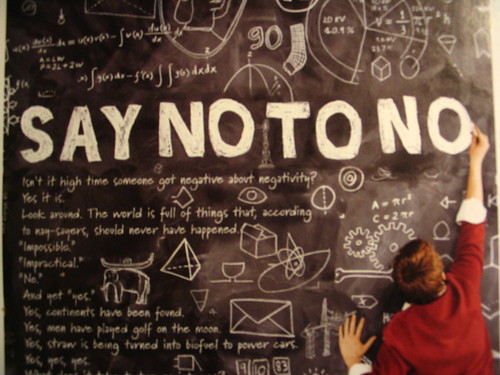
Make it impossible to say "no"...

by Friday, July 10, 2009
I tried to link this directly, but for some reason the link was completely jacked and wouldn't show me the essay on its own. I didn't want to link you just to the blog and then make you scroll to look for the article in question, so I have posted it here in its entirety. But please stop by the original poster's blog at http://tipsfromthehip.blogspot.com/ and express your appreciation if you like the essay.

In the article below, really like the idea of framing new ideas in such a way that it is not a black and white "fail/succeed". As a teacher, my instincts are often to give my students all these up-front provisos and caveats and warnings when they are trying something new, to try and help them understand that it may be difficult and to encourage them to not to be frustrated by the attempt should they not "get it" right away. But really, aren't I just setting up an expectation for frustration or failure by planting that seed at the outset? Would it be better to practice the "Daughers of Rhea Way", and simply say "try it"? Read on and let me know what you think...


Melina's Tray of Candles

From birth I was thrown into all aspects of belly dance – both the art and the business of it. I naturally accumulated skills because I had no choice: my mother knew the secret of making it impossible to say no. I was thrown into it like a newborn is thrown into a tub of water and finds it can swim to the surface.

Mom never prefaced anything by saying: “This is a hard thing to learn. If you practice every day, maybe you’ll master it enough to do it on stage.” Instead she said “Hey Melina, come in here and see if you can balance this tray of candles on your head.”

I’d trot over and presto – I found I could move around the kitchen with a large bronze tray on my head. “OK now see if you can do a backbend.” And I’d find I could. “Why don’t you try it on stage tonight, just for a second, and we’ll put a few lit candles on the top, and then just take it off and give it to me when you feel it slipping or you don’t want it anymore.” How can you say no to this?


That was mom’s secret:

“Just try it this once, and then I’ll never make you do it again.”

“Why not just try it and see how you like it?”

Three decades later, that tray has never fallen off my head.

Just when I thought I was beyond my mother’s wild idea clutches, it happened again. Just last summer while we were dancing together at Karoun’s.

I had the tray on my head, and mom suddenly left the stage, shimmied into the kitchen and came back out with three water glasses. There was no time to protest, I knew what was coming. She set the glasses up in the center of the stage and took my hand and led me to them.

“Stand up and balance on these glasses, dancing all the while with the tray on your head,” she was silently telling me in her "let's try this thing" Rhea language. Gripping her hand as I gingerly felt for the glasses with my bare feet, unable to look down lest the tray should fall and trusting only in my feet, my mother’s idea and will to succeed, and the intangible higher power of my belly dance goddess guide, I stepped up onto the glasses and danced: flames flickering up from the top of my head.

Melina’s Tips from the Hip:

Just try stuff and don’t be afraid.
Just try something for a second and then stop.
Don’t be afraid of what others think.
Practice “What if,” as in: “What if we did that, and we did it while singing/balancing on water glasses/drinking ouzo from a glass without hands, only teeth to hold the glass/….”

That is the Daughters of Rhea way.

Tying it all together: soft addictions

by Tuesday, June 30, 2009
Jonathan Fields from Awake at the Wheel posts again about social media replacing actual living, which ties nicely into both my recent post on that very topic AND the soft addictions post from less than a day ago:

"People keep talking about what a huge time sink social media can become…

But, I’ve noticed something else happening with increasing frequency. It seems like more and more bloggers and social media regulars are actually living their lives through social media, rather than living extraordinary lives outside of social media and blogging, then tapping it as a means to share their experiences with a like-minded community online."

Read more at http://www.jonathanfields.com/blog/into-the-social-media-abyss/

Soft Addictions

by Monday, June 29, 2009
Thanks to Andrea Wagnon for linking me up to this over on Facebook!
http://www.medicinenet.com/script/main/art.asp?articlekey=52408


Do mindless activity and bad habits have a hold on you? Get the tow truck, you're in a rut.

By Jeanie Lerche Davis
WebMD Feature
Published Feb. 18, 2004

Downtime is America's favorite pastime. We zone out via television, the Internet, shopping, parties, movies, hanging out, and working out. Sure, some are bad habits; some are "therapy." Most are escapes from a gerbil-wheel life.

That's when it hits you: Is this all there is?

For Judith Wright, author of Soft Addictions: There Must Be More Than This, this philosophical crisis occurred when life was a flurry of activity -- and as her first marriage was ending.

"Something was missing," writes Wright. The crux of the problem: Her life had become exceedingly superficial, because of what she calls 'soft addictions.'

"Soft addictions are those seemingly harmless habits like watching too much television, over-shopping, surfing the Internet, gossiping -- the things we overdo but we don't realize it," Wright tells WebMD. "It seems like normal behavior, but that's simply because everyone is doing it, too."

Soft addictions can be a problem, Wright says, because life is to be lived and not escaped from.

It's true, anything in excess can be problematic, says Nadine Kaslow, PhD, professor of psychology and behavioral sciences at Emory University in Atlanta. "You need to ask yourself, 'How excessive is it? How much does it interfere with my life?'"

Not that all mindless indulgences are bad habits, says Kaslow. There's a place in our lives for pointless conversations, all those Seinfeld reruns, and mocha- almond fudge. "We do these things to cope with stress in our lives," she tells WebMD.

"It's legitimate after you have a stressful day, you need to chill out some," says Kaslow. "But if that's all you do, and you do it every night, all weekend, that's another matter and it's not good for your mental health.

Wright agrees. "It's when they become habitual and we're just going through the motions that they become a problem," she says. "These bad habits keep us from living a greater life of meaning and satisfaction that we really deserve."

Superficial Just Doesn't Satisfy
Upwards of 90% of Americans admit they have soft addictions, one survey showed. "I actually think it's 100%," says Wright. "I have not met anyone who doesn't have them. No matter how well off or how educated they are, everyone has them."

In relationships -- whether you're married or otherwise -- you think you're relating to each other, but often you're just sharing soft addictions, Wright tells WebMD. "You think you had a great evening at home, but you weren't really connecting. That's why relationships don't go anywhere, why they burn out."

Friendships and social occasions can be stimulating and nurturing. But they can also be very superficial. "They can be mindless, gossipy, not-making-real-contact, nonnourishing events -- if there's no depth to conversations, if you're not genuine, if you're just saying expected lines, if you're talking about other people. You're not enriching your life."

She uses herself as an example: When she let go of one bad habit -- endlessly reading magazines and newspapers -- she substituted great literature, which was more rewarding. After that change, she found herself weeding out other soft addictions. She discovered that she related differently to people in her life.

"I began speaking more deeply from my heart about my feelings," Wright tells WebMD. "I took more walks in the park, listened to great music, meditated, started bringing in flowers. The other things [her soft addictions] weren't attractive to me any more."

"Soft addictions are webs, the fabric of your lifestyle," she explains. "When you're overworking, you're addicted to gourmet coffee, then you're all jittery, biting nails, stressful, calming down in front of the tube, then you're surfing the Internet, staying up too late, and you're tired the next day. But people don't always realize the connection."

Designing New Fabric
Breaking a bad habit or soft addiction isn't easy, Wright admits. Here are some suggestions:

* Start by identifying one bad habit. Maybe you head out shopping every Saturday morning. Next time, stop at a used bookstore on your way home, and find something worth reading. This way, "you've broken the routine, and added something more nourishing to your life," Wright says.
* Find other things that you enjoy. Add more things to your new routine. Soon, you'll be cutting back on shopping sprees -- but you won't feel deprived, she says. It's what she calls, "The Math of More." "You learn to add more nourishing things to your life, so you can subtract your soft addictions. Eventually, you come to enjoy these new things so much, they crowd out your soft addictions."
* Take time to write down a bigger vision for your life. This way your new choices have a context, so they make sense in terms of your priorities.
* Don't worry if breaking bad habits seem difficult. "It's not like it's a quick fix. It's not going to happen overnight," says Wright. "It's really about learning to live the journey of life. It's cumulative. You're discovering who you really are."

Developing your dance...

by Sunday, June 14, 2009
I was tracking linkbacks and blog followers this morning and through a series of clicks I ran across a post by dancer Heather Sara from Newfoundland. She was writing about solo'ing, but more generally about how to bring her dance to a new level of polish and professionalism. I really appreciated her thoughts on it from the perspective of one doing solos or choreography, and have included a cut of a portion of this detailed blog post herein. The full post is at the link.


By Heather Sara:
"I read a snippet from an interview with Zoe Jakes recently and all of the things she said really stuck with me:

'Develop yourself as a soloist. Find your own creative voice and practice, practice, practice. Also, Find ways to get comfortable onstage, do haflas and renaissance faires. Make your own costumes, or at least have a heavy creative hand in the process. And try your hardest to not lose sight of why you are dancing, getting too wrapped up in a goal can sometimes make you forget to enjoy the process.'


I guess there are three things here that I liked. One, I have been realizing lately that to develop myself as a dancer in any context (group or solo) I need to be a better soloist. A group of dancers all dancing together without emphasis on their personalities has a time and a place and we do that sometimes in more serious pieces. But given that belly dance already looks different on every individual body, most of the time we wear totally different costumes that emphasize our personalities, and we barely even bother to body match, I think it would be weird on OhMaya if we tried to be the same in every way. We look our best when we're out there, totally nailing the choreography but also blatantly being ourselves.

Two, I'm trying to be more conscious of what I wear and how. I am realizing that not only does it seriously impact how people perceive me, it has a huge influence on how I perceive my own dancing. Not just wearing black and silver and my sad face to dance a piece with a tsiftitelli-vibe, but it's also a big part of getting into character. Am I a vaudeville vixen tonight? Or a mysterious snake charmer? Am I going with coins, chains, kuchi and tarnished metals? Or fringe, feathers, velvet and lace? When I'm feeling strong and powerful I go for the former, and when I'm feeling girly and flirty, the latter. It's not everything, and I should be able to dance technically the same way no matter what, but it's part of a mindset.

Finally, I love the idea of not getting lost in search of the elusive "success". Maybe I'll be one of the big five or ten, or however many tribal fusion dancers everybody's heard of someday. Or maybe I won't. But a teacher who I harass for advice regularly told me that a path would open up in front of me as long as I wanted (to dance) and that all I'd need to do was be open for opportunities, and that I needed to be present on that journey. I need to enjoy this part of my dance career. I'm young, healthy, learning, happy. This is great!

The technique related items I am working on in terms of solo-ing are (in no particular order and many inspired by teachers):

* learning to stay still from time to time and let everyone breathe
* hand management
* occasionally repeating myself (to make the audience feel smart)
* incorporating combos I'm comfortable with into improvised numbers
* not getting my picture taken mid-shoulder roll, chest drop or pelvic tilt
* enhancing my costumes so that they suit my music more specifically (I must be the world's only belly dancer who finds the costume thing utterly overwhelming, which is totally baffling considering my general love of clothes and accessories; I am working on it)
* mastering the entrance (first impressions count!)
* portraying what I'm actually feeling instead of filtering it through what I think I should be feeling, or what I feel like showing the audience (although sometimes that's ok) or what I'm comfortable showing the audience
* using my "power moves" to my advantage and making the most out of the things I do well"

Thanks, Heather, for sharing your list on your blog! So, dear readers, do you have a list of your own? What would you put on it?
-Shay

Art Is A Verb, Not A Noun

by Monday, June 08, 2009
http://www.artadvice.com/advice/article20.php

"Most people don't realize how much courage it takes for an artist to show their work to people. Courage, as defined by Mark Twain, is not the lack of fear, but rather being able to move forward in spite of it. In my previous article, If You Are Addicted, I introduce the notion that there is a difference between making art and making a painting (sculpture, photography, or whatever your medium is)...

As I define it, art is the activity that occurs in the space that exists between my eyeballs and that object you have created. It is the interaction between the collective experiences in my brain, as I process the way you have chosen to express the collective experiences in your brain. It is only when this exchange takes place, that your work becomes art. It is when you share your creation with the outside world that you truly become an artist. "

Know Your Venue:

by Tuesday, June 02, 2009
Know Your Venue
A fantastic article by Seattle's own Laura Rose on considerations one must take into account when planning a performance.

Hulu has some dance...

by Tuesday, May 19, 2009

If you like dance like I like dance, you are always drawn to movies and television which features dance and movement. C'mon, you loved Bring It On, Centerstage, Save The Last Dance, Step It Up, Stomp the Yard, and even Showgirls. You call them your "guilty pleasure", but what's to be guilty about? We love to watch dance!

Well Hulu has some dance videos on demand. Not much, but some. Here are some highlights I just dug up:

A snippet of the Roxanne Tango from Moulin Rouge. Click here and find other 2 minute clips from throughout Moulin Rouge (one of my fave movies).
http://www.hulu.com/watch/14222/moulin-rouge-a-dance

Nigel Lithgow giving his own angle on the performers from Superstars of Dance. Unfortunately, I thought the show somewhat lame, but Nigel's insights into the different groups and dance styles, as well as some of the clips from the show--sans the insultingly biased country-by-country voting and insipid meanderings of The Lord of the Dance-turned-MC, Michale Flatley--are fun to watch online!
http://www.hulu.com/watch/50985/superstars-of-dance-gumboot-roots

Don't miss Team South Africa, Tam India's Rajasthani dance, and the Australian modern dance group (can you say boundless energy?!)
http://www.hulu.com/superstars-of-dance

Step It Up and Dance, which I am surprised to learn is a show I had never heard of before (maybe it wasn't all that good?), is hosted by Elizabeth Berkely and is a competition dance show. There are some fun clips among them..and there are a looooot of clips. Pages and pages.
http://www.hulu.com/step-it-up-and-dance

There is also an...interesting...series on LiveMojo on bellydance.
http://www.hulu.com/watch/23591/livemojo-guide-to-belly-dancing---dance-1
Just search for "belly dance" in the search box to see them all.

There are a lot of links to ABC's Dancing With The Stars online lessons and "dance tips", but I have never been a big fan of the show. You can see them on ABC.com if you are a fan!

Oh and here are some clips from Bring It On!
http://www.hulu.com/bring-it-on

Do you have a favorite online source for video outside of the usual YouTube and Google videos?

On The Importance Of Dancing With Beginners

by Sunday, May 10, 2009
On doing some dance reading around the 'net, I came across this brief article randomly and really loved it. It is about ballroom dancing/partner dancing, but was so absolutely true for Tribal Group Improv/ATS I bookmarked it for later reference. Thought I would share it with you here!

"On The Importance Of Dancing With Beginners
While there is no question that dancing with a better partner will make you *look* good, and that with such a partner you can concentrate more on styling details and so on because the lead and follow doesn't need so much attention, it is not the best way to practice lead/follow skills. If learning leaders only dance with accomplished followers and vice-versa, they won't develop great leading/following skills, because they won't *need* to. Now let's suppose that YOU are a great leader or follower. What happens if you dance only with other great dancers? Your lead and follow skills will gradually *deteriorate* -- because you're not working them very hard. After some months without exposure to beginners, you may be surprised to find that you can't dance with them very well, even though they seem to do okay with other beginners.

More after the jump...


You learn how to dance better by dancing with more experienced partners. But you learn how to lead/follow better by dancing with less experienced partners. Your skills are put much more to the test dancing with a beginner than with an experienced dancer. It is easy to lead/follow a great dancer. All your weaknesses as a leader/follower show up with beginners. Dance with them and ask yourself why each incorrectly led/followed figure didn't work and when you figure it out, work on incorporating the fixes into all your dancing!

You cannot become a good dancer by dancing _only_ with the same person. Dancing only with each other, you will become good at dancing with each other with all the mistakes and bad habits that become "correct" for you.

There is a certain type of character (leader) that one encounters again and again if one has been dancing for any length of time: the guy who only wants to dance with the best followers because he believes they are the only partners who can match his high skill level. Often what is REALLY going on is that only the best followers can compensate for his mistakes or idiosyncrasies. They make him look good. But the guy continues to think he's the tops because he insulates himself from feedback. *Dancing with poor to average followers is a good reality check.* If none but the best can follow your leads, I respectfully suggest your leads could use some work.Also, that kind of thinking ultimately harms their dancing. I've seen guys overestimate their ability and abandon the study of technique FAR too soon. Consequently it will take them a lot longer to reach the next level of skill.

(This file is part of the lead/follow FAQ list. These are articles compiled from the newsgroup rec.arts.dance by Mark Balzer.)

(You may link to this page and make copies for private use in any form, but reproduction in any means, including book or CDROM, is not allowed without permission from the copyright holders.)
"

Ego vs. Pride

by Thursday, May 07, 2009

I really dig this article on Wisegeek examining the sometimes subtle, but important, difference between ego and pride. In my estimation, ego can get in the way of progressing in our dance, while pride can be motivating and bolstering in our attempts. What do you think? Read on...

Since ego and pride are rather linked, and their definitions are so similar, it can be difficult to figure out exactly how they are different. However, a simple way to consider ego and pride is this: ego is rather selfish and often has no basis in fact while pride tends to be less selfish and is typically based on the facts of a person's achievements and qualities. Some people think of ego as self-respect. While it can lead to a sense of self-respect, it too often leads to arrogance instead.


When a person has a genuine ability in a particular field, this could be a source of pride. Instead, however, the person may begin to feel that he is the best in this field and that no one else is or ever will be worthy of working with him; he may feel this way regardless of whether or not there's actually any truth to his perceptions. Pride, on the other hand, would make this person feel happy about his skills and accomplishments, without having to be the best or only one capable of achievement. Pride leads to confidence instead of the arrogance.

Ego and pride may also differ in terms of strength. Often, the ego is easily bruised while true pride is harder to shake. For example, ego often comes into play in dating situations. A person's ego may be hurt when a love interest suddenly becomes disinterested or criticizes certain physical attributes. If a person feels true pride in the things that make her unique, however, she may feel disappointed, but her confidence won't take a serious hit; ego is so frail because it is often built on exaggeration.

Ego and pride also differ in their effects on relationships. A person's ego may cause him to behave chauvinistically, put down another's attributes, or refuse to date someone whom he feels is beneath him. Often, these behaviors are rooted in hidden insecurities. The ego can mask them but not make them go away. If the person has real attributes to be proud of, however, his insecurities may lessen or at least become less pronounced.

Another difference in ego and pride is that pride may also be focused on others instead of being self-obsessed like ego. For example, a person's ego may cause her to think her children are the most well mannered; after all, how could she have children who are rude or crass? Pride may instead be focused on the things that are special about her children. For example, she might be proud of them for holding doors for other people or volunteering at a soup kitchen. A person can even feel proud of a wide range of other outward things, including her employer, neighborhood, or country.

It's important to note that ego isn't all bad. Your ego is simply how you view yourself. If you give it a firm basis in reality and do not allow it to control your life, it can actually be good for your self-esteem to have both an ego and pride.

The quality of a teacher...

by Tuesday, April 28, 2009

Posted by Ali of n.o.madic tribal, taken from a yoga blog kept by a Jivamukta:
http://athayoganusasanam.blogspot.com/

Thanks for sharing this wonderful sentiment, Ali!

"Teachers are extensions of their masters. Average teachers are merely mimicking their masters. The great teachers have found the master within from which they project.

Teachers are not measured by what they know. They are measured by what they can instill. True teachers are supposed to enable their students to become self sufficient, strong and independent people who choose to be with them. Quality teachers remove codependency and or attachment from the relationship. The ultimate goal of teachers is to make students into masters. By doing the latter the student is free. Students who experience this should never forget where the direction came from.

The quality of the teacher is defined through the student’s practice. As the student grows so does the teacher. Thus the student’s progression is the teacher’s top concern."

And Asharah does it again...

by Tuesday, April 21, 2009
So part of why I dug up my older kudos-post to Asharah is because she continually asks the tough questions, and gives some thought-provoking and worthy answers. Her most recent post about "Vintage Fusion Bellydance" is again right on the money with regard to the Victorian/Burly fusion fad. Here is a snippet to whet your whistle, then pop over and read the entire thing!

"What if someone from the general public came to see one of these performances? What if this person knew nothing about bellydance? Do we want to give the general public the impression that we’re only comic relief and slapstick acts that have no qualms about showing our frilly panties to strangers, particularly as we lose (or pretend to lose) our inhibitions through the imbibing of alcohol on stage? Is that bellydance, and, more importantly to me, is that tribal? And, I know that many of us bellydancers are trying very hard to elevate this dance into the realms of both popular and high art… and in order for that to happen, we must earn the respect of not only our peers but also the general public. How do we expect to be respected as an art form when we’re stumbling around on stage in our underwear?"

PLEASE VISIT MY DANCE BLOG!


On this blog I share my personal posts about cooking and knitting, travel and other musings; while I will blog about dance-specific topics over on the Deep Roots Dance blog:
http://www.deeprootsdance.com

I hope you will enjoy both my sites. Thanks for visiting!
Powered by Blogger.