On the importance of communication

by Monday, September 20, 2010
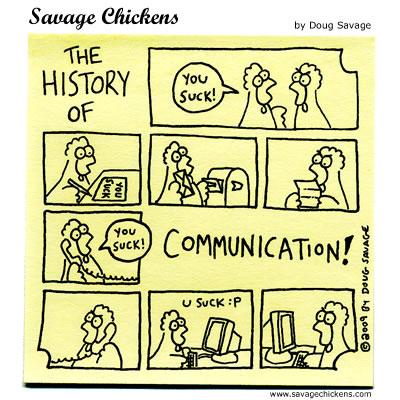
The last six months has really given me a lot of time to reflect on the importance of communication, and it has been reiterated in the last month with various important discussions I have been a part of.  What we say, how we say it, when we say it, why we say it, and even who we say it to...there is a delicate combination of each of these considerations that makes for successful communication.


My preferred mode of communication is the written word. It has always been the case for me that I feel I can best consider each of these variables when trying to express my thoughts and feelings to others through writing. Even before the internet and e-mail, I preferred writing notes and letters to friends and family to express important thoughts, because it was easier and more natural for me.  I find that when I talk on the phone or in person, any number of these variables cannot be fully honored--the way things are said and the "when" of what is said is dependent on the timing of the opportunity to connect in real-time with someone.  Some days I just don't feel that eloquent. Most days I feel like, when it comes to really important communications, I can't think it all the way through, and say everything I want to say, and I leave the conversation with words roiling in my mind for hours or even days following, dredging all the things I wish I had thought to say at the time.  With writing, I can pick the time and I can carefully pick my words. I have time to consider why I am saying what I am trying to say, and how I want to express it.

The only lingering problem is the Other End--their interpretation of the message and tone (the "what"), and what headspace they are in when they read it (the "when" of receiving the message determining how open or able they are to hearing and processing what is being said).  The most carefully and thoughtfully crafted missive can jag off in the most unexpected and dismaying directions based on how and when it is read by the receiver.  We have no control over that. It's the gamble we take when we use mail or blogs or other forms of written online communication to try and express something significant to others.

I have had a lot of opportunity to think about words, spoken and written, in the last six months. And the thought I keep coming back to is: we are imperfect. As a human, I am imperfect.  I can't say everything right, and even if I did, it wouldn't always be heard the way it was meant. Those we speak to are human and imperfect, and they may not intentionally misconstrue or misunderstand what you say--they have their own experiences which filter what they hear.  And if in the end there still lingers hurt or fear or doubt surrounding what was said, and those involved aren't willing or interested in asking questions--talking it through no matter how hard it seems to do so--and getting to the root of what you really mean (not just what they think they heard), you may forever be misunderstood. And as hard as it is, you have to let that go, knowing you did your best

I can see both sides of this. I can see how hard it is to sincerely try and make yourself understood, and feeling like you have failed no matter how much you poured into it. And I can see those who hear the message through their own personal filters, and feel hurt or confused, but are fearful of digging any deeper and risk feeling more wounded.  I can feel both sides of that equation, and how heartbreaking it can be--you feel trapped by your own words (or inability to find the right ones).  I have been there, and still have lingering wounds...
A Not So Radical Idea (ATS Old School vs. New School)

by Saturday, September 18, 2010
I am definitely seeing and hearing a lot of confusion and frustration and fear surrounding the old vs. new announcement made this week. And I completely understand the mix of emotions this is stirring up. BUT...


Maybe (it's worth trying at least...) if we concentrate on the spirit of the announcement--the idea that dancing should be fun and creative and empowering, not super-strict and limited and single-pathed (hey I made up a word!)--we can manifest it in ourselves and in the community. 

I know that sounds really Pollyanna, and it will not make all of our mixed and confused feelings go away, but think of it as a meditative practice to help come to a place of balance as everyone is hammering out their feelings.

I humbly suggest that we attempt to push our energies to the positive and exciting possibilities this creates within the artform. Think of it in a bigger picture than our own personal understanding and desires, and more about what this will enable and empower the community at large to build upon... Rather than think of the worst case scenarios of abuse and misrepresentation of the name and art we are so quick to envision; instead think of the BEST case scenario, where incredible fresh ideas flow and beautiful art is made over and over again on this base we all love so much! Where both those who choose to uphold the common standards of the classic form and those who respectfully build upon it can be equally embraced and encouraged.

Rather than picture it as another divide, think of the ways in which it will bring people in closer and encourage them to be a part of the "family", with all our individual beauty and flaws we bring to our dance vision.

There will always be people who don't "get it", and will, intentionally or unintentionally, misrepresent ATS in name and in spirit. But let's not allow ourselves to dwell on that small group. Let's look at the larger community of intensely passionate, incredibly creative, and humbly grateful dancers who can do so much to keep the spirit of ATS alive, whether it be old school or new.

I think we should still feel free to talk about the ways in which people feel upset, and explore the ramifications of this decision from all angles. But I offer this suggestion to help us move gracefully through personal emotions and maybe help us be more zen about things as we endeavor to understand the bigger picture.

I can only imagine this positive, encouraging slant is just what Carolena had in mind when she made this decision. And I hope we can find a way to support her in that, even as we try to come to terms with other more challenging thoughts.

Teacher Loyalty Redux

by Saturday, September 18, 2010
Because I think it bears repeating, and with a little caveat added to the end:

"To All Students,
Regarding "Loyalty" to Your Teacher
By Amanda Niehaus

with a few edits by me personally
(originally posted at Shira.net which is a fantastic resource for all things bellydance. Check it out!)

Dear students of this beautiful art form,

I am a teacher. I teach because I am passionate about this dance and I want others to share my passion.

I am not teaching because I require a fan club.
I am not teaching because I require devotees or because I need hero worship.

As your teacher, my job is to teach you; to inspire you to be your best. If I am a really good teacher, then I also will not be your only teacher.


I will encourage you to study with other teachers who have skills and experience I lack. Because I am not the end-all, be-all of bellydance knowledge.


You as a student owe me nothing. You may thank me after class, you may credit me on your first performance DVD, you may remember me when you are touring with Jillina, but you do not owe me anything. (You paid for your class. I taught you. We are even.)

I am an emotionally-mature adult. I do not require your "loyalty" or allegiance. You do not have to take my classes just because I offer them, or just because I was your first teacher. You will not be "cheating on me" by taking classes with another instructor.

You should be taking my class because you enjoy it and are learning something. If you are no longer enjoying it or learning from it, then I would be the first to encourage you to find another, or a different, teacher. I want you to love this dance as much as I do.

Your job is to learn and practice, not to worry about my ego. I will not be "mad" at you for moving to a new (style or place in your dance). You need to worry about YOU, and making yourself a better dancer. I will never resent you and I will only respect you for moving on...(if that is your desire)

Do what's right for you. I'll be fine, whether I'm dancing beside you or watching you from the audience. I promise.

Yours truly,
Your dance teacher"

Caveat:
In a dance which is so much about community, as ours is, it is respectful and thoughtful to check in with your teacher from time-to-time--not to seek approval, but simply as a show of gratitude for what she has shared with you. It is not required, and her love for you is not contingent on whether you do or not, but it is a kind gesture for someone who cared for you as much as your teacher has (and yes, she still does, whether you have been around five years or six months). If your teacher has moved you, nurtured you, encouraged you, even friended you, consider a little 'thank you' in the form of simple friendly communication now and then. Tell her what you're up to. Ask how she's been. Nothing earth-shaking is necessary. Very little goes a long way.

More reading on teacher loyalty:
Yoga Teacher Loyalty

What makes a good/bad teacher?

by Friday, September 17, 2010
http://danceadvantage.net/2010/08/11/define-dolly-dinkle/

I had never heard of a Dolly Dinkle before, but it sounds all so familiar when compared to complaints and opinions voiced in the bellydance community. All artists have the same concerns...

One commenter wrote:

"Dolly Dinkle schools offer no technique or curriculum. Their schedule often reflects whatever is hot at the moment- lyrical, contemporary instead of ballet; all hip-hop; etc. 

Dolly doesn’t teach vocabulary or history of the dance forms. Ballet is not the only genre with this! So many students don’t realize hip-hop and breakin’ have a vocab and history! 

A well-rounded education: technique, history and vocab PLUS improv, choreographic, and performance opportunities makes a great studio."


Another poster commented:


We have a responsibility as teachers to keep advancing the field and ourselves through continuing education.  Since there is no standard in dance education, teachers have such varying levels of training, education, and certification. But as we all know, there are fantastic teachers with no performance experience, no degree, and no certification, and there are others who danced with ABT, have college degrees and five page resumes and are horrible teachers. It’s the teachers who continually seek knowledge and collaboration in the greater dance community who avoid pigeon holing themselves into a “Dolly Dinkle” atmosphere. 
For me personally, I think it comes down to motivation. When you sink into a routine and just “teach what you were taught”, that’s a tell-tale sign of my definition of a Dolly Dinkle. You have to continually analyze and assess: What are the needs of my students? What can I do to meet those needs? Is this a safe environment for my students? Is this a supportive environment for my families? Would I sign up my kids for my classes? It’s one thing to open up a studio with a concrete floor. Everyone has to start somewhere. But to ignore it for 10 years is quite another thing.This is fantastic! I think Maria made an interesting point about “teaching what they were taught.” We have a responsibility as teachers to keep advancing the field and ourselves through continuing education. The conference Nichelle is attending this week is a perfect example! Since there is no standard in dance education, teachers have such varying levels of training, education, and certification. But as we all know, there are fantastic teachers with no performance experience, no degree, and no certification, and there are others who danced with ABT, have college degrees and five page resumes and are horrible teachers. It’s the teachers who continually seek knowledge and collaboration in the greater dance community who avoid pigeon holing themselves into a “Dolly Dinkle” atmosphere.

And there are a couple other great comments in there as well.

What would you say is the mark of a good teacher? What were some traits of bad teachers you have encountered? And do you think there should be some kind of regulation? Why or why not?

ATS - The new definition from Carolena

by Thursday, September 16, 2010
At about 5pm this evening, Carolena has officially expanded her definition of ATS. Here is the latter portion of her announcement this evening. I would love to hear what you think.

"There is still some confusion about what is ATS and what is any variety of Tribal, but that's OK. We have Sister Studios, teachers that adhere to the philosophy of FatChanceBellyDance in their ATS classes, 98 at the time of this writing. We have TribalStar Galactica, my attempt in getting all the "tribes" together in one place, no matter of the genre, 247 at the time of this letter.

It's finally time for me to give the gift that I had intended at the filming of Dance Fundamentals-be creative and have fun.


There are so many new steps and concepts being presented to me that I feel the need to broaden our definition of ATS. I propose that the steps from Tribal Basics Vol. 1 Dance Fundamentals and Tribal Basics Vol. 4 Embellishments and Variations be considered ATS Old School, as they are the foundation of what we do. Everything else, including our Tribal Basics Vol. 7 Creative Steps and Combinations, are to be considered ATS New Style.

There will be new steps added to the ATS vocabulary, but they will not be mandatory. As well, you are free to create new steps and variations of your own. You can show them to me, or not. I am always happy to give a common sense creative critique on what makes a good ATS step, but you will not get in trouble if you are moved to create something on your own.

As one dancer recently brought to my attention, we all have our own dialectics. By the nature of either distance, ala FatChance and Devyani, or simply a student group that dances together on a regular basis, we develop our own creative steps and variations (more on how to do that at the end of this letter.) The dance is the same but experimenting and mistakes lead us to create, and that's a good thing.

But here's the deal; if you choose to create your own thing you will not be able to flow with another ATS dancer that you have never danced with before. What do I mean by flow? Flow is when both dancers have the same muscle memory for steps, interpret the music in the same way, have a similar skill level and use the ATS formations of duet, trio and quartet. Flow is dancing in the divine subconscious. But if you have one version of a step and another dancer has a different version, you will have to discuss it ahead of time and you will have to think, or stay in the conscious while you dance. This is not a bad thing, but just be aware of it.

So that's it.

I'm still on the scene. I will still be teaching ATS all over the world. We will continue to produce instructional DVDs. I'm not going anywhere. In fact I'm just sitting here on the porch and I invite my dance family to come and play in the front yard. Show me what you are doing, tell me how it has changed your life, share a new piece of music with me. Just come home for a spell and let me enjoy your happiness. Then you can run off to the next house and create yet again.

Anatomy of a Step.
In June of 2011 we will shoot the next instructional DVD, to be released in the Fall. It will be titled Anatomy of a Step. We'll introduce you to the new work that we are doing as well as that of guest artists. The theme of this DVD will be to introduce you to the process of creating steps and variations. But for now, use this formula: the posture does not change. The ATS Old School steps remain the core. The result of a new step reinforces the aesthetic of uplifted arms and joyful display of the body. The step conveys happiness. Any cues should be brief and logical, the more "rules" you have to add, the less successful the step will be. The principals of non-verbal communication govern all cues and formations.

I think that if you follow these suggestions you will have success, and I hope find more depth in the dance.

My friends, enjoy the dance. And phone home every now and then.
Best wishes,
Carolena"

PLEASE VISIT MY DANCE BLOG!


On this blog I share my personal posts about cooking and knitting, travel and other musings; while I will blog about dance-specific topics over on the Deep Roots Dance blog:
http://www.deeprootsdance.com

I hope you will enjoy both my sites. Thanks for visiting!
Powered by Blogger.